Investigations
MANGAUNG’S MISSING JOBS: WHEN A CITY STOPS CREATING OPPORTUNITY
There is a number that should worry every political party campaigning in Mangaung: 29,000.
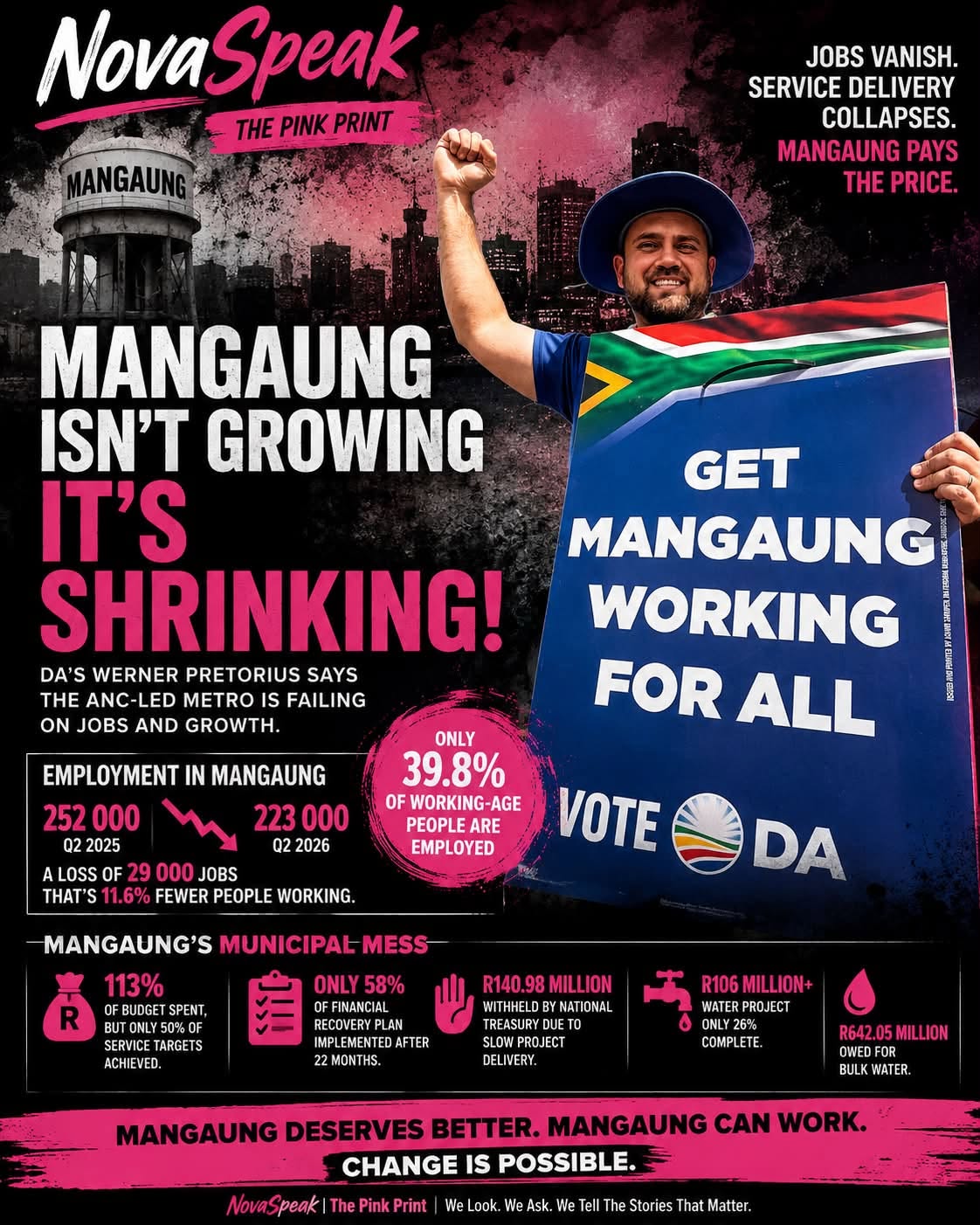
There is a number that should worry every political party campaigning in Mangaung: 29,000.
That is the reported number of jobs lost in the metro over the space of a year, with employment falling from roughly 252,000 people in the second quarter of 2025 to about 223,000 a year later. On paper, it is a statistic. On the streets of Mangaung, however, it represents something far more personal — households losing income, graduates carrying CVs from one door to another, parents trying to stretch shrinking incomes, and young people increasingly questioning whether the city they call home can still offer them a future.
South Africa's official unemployment rate stood at 33.6% in the second quarter of 2026, according to Statistics South Africa's Quarterly Labour Force Survey, but the figures being used in the political debate over Mangaung point to an even more troubling local picture, with only about 39.8% of the metro's working-age population reportedly employed. The numbers should therefore force a question beyond the usual unemployment debate: why is Mangaung losing jobs at a time when the city desperately needs to be creating them?
For DA Mangaung mayoral candidate Werner Pretorius, the answer is rooted in municipal leadership. He has argued that the ANC-led metro has failed to create the conditions necessary for economic growth and has contrasted Mangaung's reported employment decline with Cape Town, where he says employment increased by 3.2% over the same period under DA governance. Pretorius has framed that difference as the “DA difference”, turning employment into another battleground in the approaching 2026 Local Government Elections.
But if Mangaung's jobs crisis is going to become an election issue, it deserves to be examined beyond the slogans of either party. The uncomfortable reality is that jobs do not exist in isolation from the city around them. Businesses need reliable water and electricity. Investors need confidence. Construction projects need to move. Roads need to be maintained. Municipal applications need to be processed. Contractors need to be paid. Infrastructure needs to be completed. And public money needs to produce visible economic activity.
When those systems begin to fail, the consequences do not remain inside municipal offices. Eventually, they reach the labour market.
That is why Mangaung's employment figures cannot be separated from the municipality's wider financial and service-delivery problems. Parliament's Standing Committee on Public Accounts has already raised serious concerns about the metro's performance, with SCOPA hearing that Mangaung spent 113% of its budget while achieving only 50% of its service-delivery targets.
The significance of those numbers goes far beyond municipal accounting. A municipality spends public money with the expectation that something tangible will happen because of it — a road will be repaired, a pipe will be replaced, infrastructure will be constructed, a service will be delivered or a development project will move forward. When spending exceeds the budget while only half of the targeted service-delivery outcomes are achieved, residents are entitled to ask what happened between the money being spent and the promised results appearing on the ground.
That question becomes even more difficult when Mangaung's Financial Recovery Plan is considered. After 22 months, only 58% of the plan's activities had reportedly been implemented, leaving the metro still operating within what has been described as the “rescue phase”. For a municipality already struggling with financial and governance challenges, a recovery plan is supposed to provide a route out of crisis. When implementation itself becomes slow, the recovery begins to look less like a journey towards stability and more like another destination that keeps moving further away.
And while the municipality struggles to implement its own recovery programme, the consequences are being felt through projects that are supposed to stimulate development. National Treasury reportedly withheld R140.98 million because of slow project implementation. A water project worth more than R106 million was only 26% complete, while Mangaung owed R642.05 million for bulk water.
Those figures might appear at first to have little connection to unemployment, but they tell the same story from a different angle. A stalled infrastructure project is not simply a construction site that has stopped moving. It can mean a contractor unable to progress, suppliers losing business, workers never being hired, local businesses losing potential customers and communities continuing to wait for infrastructure that was supposed to improve their lives.
For a city struggling to create employment, every delayed project is therefore more than an administrative failure. It is a missed economic opportunity.
The same is true of Mangaung's water crisis. Parliament has raised concerns about water losses, with almost half a billion rand worth of water reportedly being lost through leaks, burst pipes and illegal connections. To a resident, however, that figure does not appear as a line item in a report. It appears as a leaking pipe that remains unrepaired, an interruption that disrupts a household or business, a burst pipe that becomes part of the landscape, or infrastructure that deteriorates faster than the municipality can maintain it.
For businesses, those failures can have an even wider impact. A company deciding whether to invest in Mangaung is not looking only at property prices or available workers. It is looking at whether the city can provide the basic infrastructure needed to operate. It is looking at reliability, predictability and confidence. If those foundations become unstable, investment decisions can change — and when investment slows, the employment opportunities that come with it can disappear before they ever reach the job market.
This is the uncomfortable reality of local economic development: government does not have to employ everyone to influence employment. It has to create the conditions in which businesses can invest, expand and employ.
That means functioning infrastructure. It means efficient administration. It means financial stability. It means projects that move from tender to construction to completion. It means suppliers being paid and municipal assets being protected. It means water systems that work, roads that are maintained and public money that produces public value.
Without those foundations, economic growth becomes increasingly difficult to sustain.
Mangaung has already travelled through provincial and national intervention in attempts to address its governance and financial problems, yet the employment figures suggest that whatever recovery is taking place has not translated into enough opportunities for residents. That should concern the governing ANC, but it should also force opposition parties to explain precisely what they would do differently.
Pretorius and the DA are entitled to point to the municipality's failures. That is the role of an opposition party. But identifying failure is not the same as proving an alternative.
If the DA wants Mangaung residents to believe that it can turn the city's fortunes around, voters should demand specifics. How many jobs will be created? By when? Which sectors will be targeted? What investment will be attracted? How will local businesses benefit? Which municipal processes will change? Which infrastructure projects will be prioritised? And, perhaps most importantly, what measurable targets will residents be able to use to determine whether the promises were actually delivered?
The same standard must apply to the ANC.
The governing party cannot simply point to national unemployment and argue that jobs are primarily a national responsibility. While local government does not control every aspect of the economy, it controls enough of the local environment to influence whether businesses can operate, whether infrastructure is delivered and whether development moves efficiently. Mangaung's leadership therefore has a responsibility to answer the concerns raised by Parliament, the Auditor-General and the employment figures with more than political explanations.
Residents need results.
They need to see that financial recovery is actually recovering something. They need to see projects being completed. They need to see infrastructure working. They need to see public spending producing outcomes. And they need to see an economy in which being young does not automatically mean being unemployed.
Because the human cost of a failing local economy is rarely captured by the headline number.
Behind the reported 39.8% employment figure is someone looking for work. Behind the 29,000-job decline are households absorbing an economic shock. Behind the 113% spending figure is public money that was expected to produce public outcomes. Behind the 50% service-delivery achievement is work that residents were promised but have not fully received. Behind the 58% recovery-plan implementation rate is a municipality still struggling to execute its own turnaround. Behind the R140.98 million withheld by National Treasury are projects delayed by implementation problems. And behind the unfinished water infrastructure is a city being asked to believe that economic development can happen without reliable basic services.
It cannot.
That is why Mangaung's jobs crisis should not be reduced to an ANC-versus-DA argument. It is a test of whether political leadership — regardless of party — understands the relationship between governance, infrastructure, investment and employment.
The ANC cannot simply point to its plans.
The DA cannot simply point to the ANC's failures.
Both must explain what comes next.
Because voters should not have to wait another five years to discover that a manifesto was easier to write than a job was to create.
As the 2026 Local Government Elections approach, Mangaung's employment figures could therefore become much more than another campaign talking point. They may become a referendum on the city's ability to govern, deliver and create an environment where opportunity can actually take root.
The question facing Mangaung residents is not simply who should run the city?
It is whether whoever runs it can make it work.
Can municipal spending become infrastructure? Can infrastructure attract investment? Can investment grow businesses? Can businesses create jobs? And can those jobs give young people a reason to believe they can build a future without having to leave the city in search of one?
Mangaung does not need another political slogan about opportunity.
It needs opportunity to become visible.
It needs projects that move, businesses that grow, infrastructure that functions, public money that delivers and young people who can finally hear something other than “we are creating jobs” when they ask the most basic question of all:
Where is my opportunity?
Until Mangaung can answer that question with something more tangible than another promise, the city's missing jobs will remain more than an economic statistic.
They will be evidence of a city still searching for a way to turn its potential into progress.
NovaSpeak | The Pink Print
We Look. We Ask. We Tell The Stories That Matter.