Community
The Question Is Simple
Why Are We Not Using the People Already Willing to Protect Their Communities?
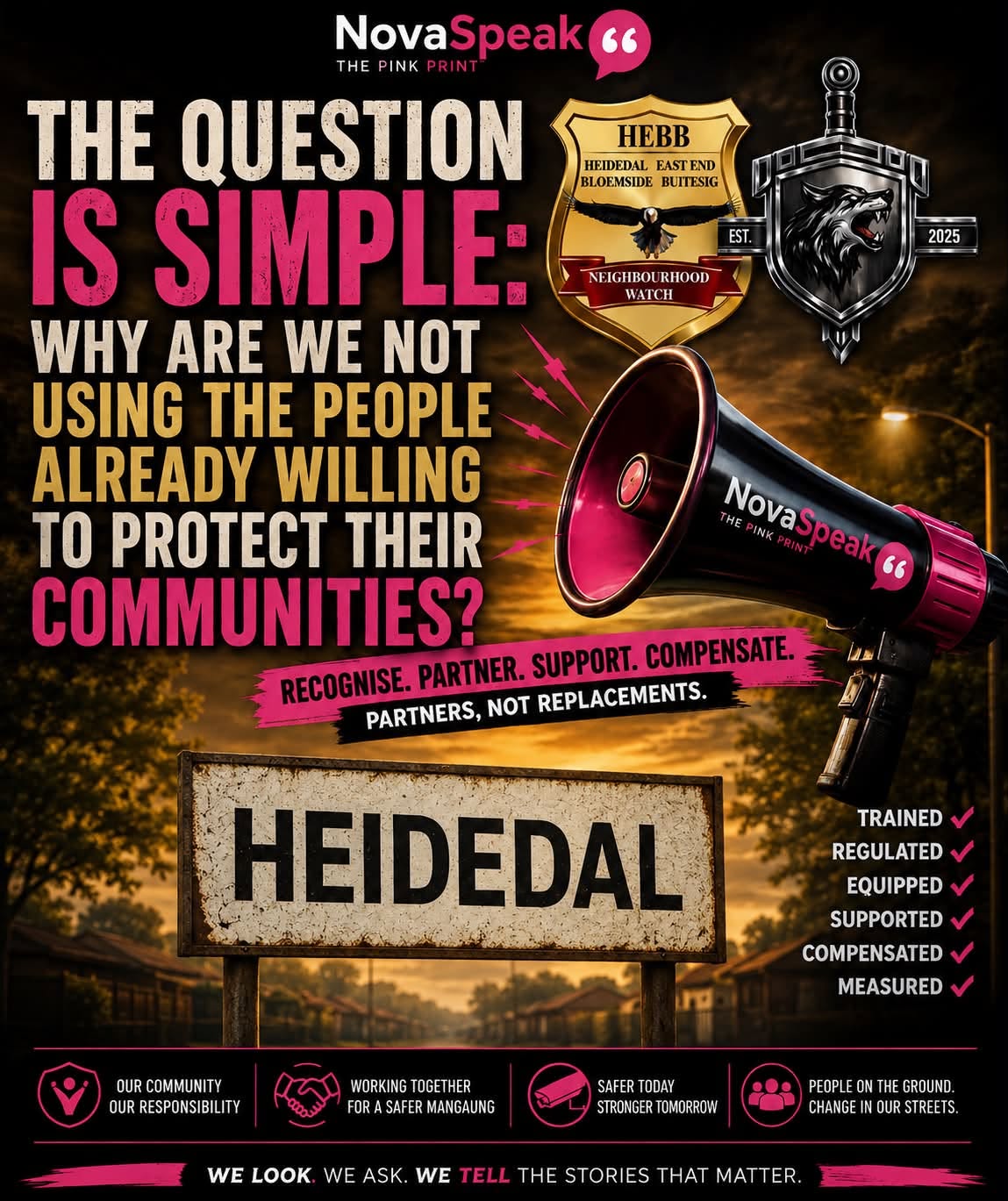
There is a question Mangaung Metro should be asking itself: why are we not making better use of the people who are already willing to protect their own communities?
In Heidedal, residents have repeatedly demonstrated that community safety is not simply something they talk about. They patrol. They report suspicious activity. They assist during emergencies. They work alongside police and emergency services. They watch over schools, infrastructure and public spaces. And when something goes wrong, they are often among the first people on the scene.
So perhaps the conversation should no longer be about whether neighbourhood watches have a role to play in community safety.
Perhaps it should be about how that role can be recognised, regulated, supported and, where the law permits, properly compensated.
As Basie Kok put it bluntly: “Guys, I hear you. If the Neighbourhood Watch could take over security at our recreational facilities, things would go much better and look much better.”
It is a statement that deserves to be unpacked carefully, because “take over security” cannot mean replacing the South African Police Service, giving volunteers police powers or creating an unregulated parallel security force. That would be neither responsible nor desirable. What it can mean is creating a clearly defined partnership in which established community safety structures are given the training, resources, supervision and legal framework necessary to assist with protecting public facilities.
And Heidedal has already provided evidence that such a partnership is not merely an idea.
The Heidedal, East End, Bloemside and Buitesig Neighbourhood Watch — HEBB — is an established community safety role-player. Its members have worked to protect residents and have become involved in incidents ranging from housebreaking and petty theft to serious threats facing schools, infrastructure and public spaces.
In November 2023, information provided by HEBB members, together with police and Centlec investigators, contributed to an operation that led to two suspects allegedly being caught burning copper electricity cables valued at approximately R4 million. The suspects were arrested.
That incident matters because it demonstrates what community involvement can look like when it connects with formal law enforcement. The neighbourhood watch did not replace the police. It provided local knowledge and information that helped police and investigators act.
Then, in August 2025, when a fire broke out at Dr Blok Secondary School — reportedly the third fire at the school in just over five years — neighbourhood-watch members helped evacuate learners and made space for firefighters. Their cooperation was recognised by the Mangaung Fire Department as an example of community solidarity.
Members also conducted after-hours patrols around Heidedale Secondary, Olympia and Credence Primary. The purpose was not to turn volunteers into police officers, but to create a visible presence around schools and help address concerns including drug distribution and use among learners.
These incidents tell us something important.
Heidedal already possesses a resource that many municipalities spend enormous amounts of money trying to create from scratch: people who know the community and are prepared to act.
The same people were there when another tragedy unfolded at the Heidedal Quarry in October 2025.
A 20-year-old man reportedly drowned at the site, prompting a search-and-rescue operation that continued for days. SAPS search-and-rescue personnel were involved, while private security and neighbourhood-watch members assisted, including searches supported by drones. The young man's body was eventually recovered on 23 October.
For the people involved, this was not simply another incident appearing in a news report.
It was a neighbour.
It was someone's child.
It was a family waiting for answers.
It was a community confronting a danger it had been warning about for years.
That is why the Heidedal Quarry cannot simply be treated as another abandoned or neglected piece of land. Parliamentary oversight bodies visited the site in 2025 following serious concerns about safety, rehabilitation and regulatory compliance, while parliamentary documentation referred to reports of more than 40 people drowning at the quarry over the years.
The tragedy raises an uncomfortable question: if the danger has already been identified and the community has already demonstrated its willingness to assist, why are residents still being left to fill the gaps themselves?
That question takes us beyond Heidedal and into the broader question of how Mangaung approaches community safety.
The Greater Mangaung Neighbourhood Watch Forum has argued that this should not be viewed as a Heidedal-only issue. Communities across the Metro have residents who patrol their streets, share information and attempt to prevent crime. Instead of expecting every community to operate independently, Mangaung could explore a coordinated model that brings established neighbourhood watches into a properly structured safety framework.
But that model must begin with the law.
Dean Maasdorp has raised precisely that concern, questioning why neighbourhood watches do not simply register as security companies when some of their activities increasingly resemble those of regulated security providers. His concern points to a legitimate debate about the boundaries between community volunteering, private security and policing.
He has also pointed to the regulatory gap in the Free State, arguing that neighbourhood watches should operate within the applicable legal framework and work through their respective Community Policing Forums.
Those questions cannot be ignored.
If Mangaung is going to involve neighbourhood watches more formally, it must ensure that participating structures are properly vetted, legally compliant, trained and subject to clear oversight. There must be no ambiguity about what members may and may not do, no informal assumption of police powers and no system in which public money is handed to organisations without transparent accountability.
The experience of the Ashbury Neighbourhood Watch, which Maasdorp has questioned in relation to CPF affiliation and compensation, illustrates why the framework needs to be clear before money changes hands.
The answer, however, should not be to dismiss neighbourhood watches altogether.
It should be to professionalise the partnership without turning community volunteers into police officers.
That distinction is crucial.
Mangaung could identify established neighbourhood watches that meet defined requirements, conduct proper background checks, provide appropriate training and equipment, establish written agreements and set measurable responsibilities. Those responsibilities could include visible patrols, facility monitoring, incident reporting, early-warning communication and assistance during emergencies, while all criminal investigations, arrests and policing powers remain with SAPS and other authorised agencies.
Where the law permits, proper compensation could then be attached to clearly defined duties.
Because there is another uncomfortable reality: goodwill has limits.
People cannot indefinitely be expected to use their own vehicles, buy their own fuel, maintain equipment, pay for communication and spend hours patrolling their communities while also trying to support their families.
Volunteering can be the starting point of community action.
It cannot necessarily be the long-term funding model for public safety.
That is not simply about rewarding people. It is about sustainability.
If Mangaung believes community participation can contribute meaningfully to safer public spaces, then it should be prepared to invest in that contribution and measure what it gets in return.
The Metro has already created a platform for this discussion.
At the Safer City Indaba held on 18 and 19 February 2026, community safety and social infrastructure formed part of the broader conversation, with Basie Kok listed in the programme as a representative of the Heidedal Greater Mangaung Neighbourhood Watch on a panel dealing with the built environment and social infrastructure.
That is significant.
The community was not simply shouting from outside the room.
It was in the room.
The next question is what happens after the meeting ends.
An indaba can bring people together. A panel can generate ideas. A speech can receive applause. But the real test begins when everyone leaves and the municipality has to turn those ideas into something residents can see.
That is where Heidedal's proposal could become a practical test case.
Why not start with one recreational facility?
Identify a facility that has safety challenges. Bring together Mangaung Metro, SAPS, the CPF and a properly vetted neighbourhood-watch structure. Establish exactly what the neighbourhood watch will do, what it will not do, what resources it will receive, who supervises it and how its performance will be measured.
Then test it.
Measure the number of patrols.
Measure the number of incidents reported.
Measure response and referral times.
Track vandalism.
Track damage to municipal property.
Track the number of facilities covered.
Track the number of people trained.
Track how many people gain lawful employment.
And then ask the most important question: did the community become safer?
If the answer is yes, expand the model.
If the answer is no, fix it or end it.
That is what responsible public spending should look like.
It would also create an opportunity to connect community safety with economic development. A young unemployed person should not necessarily have to leave their community to find an opportunity. A properly structured safety programme could provide training in areas such as first aid, communication, incident reporting, emergency procedures and community safety while creating legitimate employment where appropriate.
Imagine someone who currently has no job receiving training, passing the necessary screening, receiving the required equipment and earning an income while working in the very community they know.
That is not charity.
That is potentially an investment in both safety and people.
But once again, the safeguards matter.
There must be no political appointments disguised as community programmes. No tendering process designed around friends. No politically connected neighbourhood watch receiving preferential treatment. No unexplained payments. No vague responsibilities.
If public money is involved, the public must be able to see where it goes and what it produces.
That same principle should apply to technology.
CCTV can be useful. But a camera does not understand the community around it. It does not know that a particular pathway becomes dangerous after dark or that a particular facility has repeatedly been vandalised.
A camera can observe.
People can interpret.
A camera can record.
People can report.
A camera can identify something suspicious.
People can communicate that information to the appropriate authorities.
That is why technology and community knowledge should complement one another rather than compete.
The CCTV initiatives being developed within Mangaung should therefore be considered alongside properly structured community patrols. The strongest safety network may not be technology alone or people alone, but technology connected to people who know the area and to authorities who can respond.
The same thinking should be applied to abandoned municipal buildings.
Why should public buildings sit empty until they become vandalised or occupied illegally when communities are desperate for safe spaces?
Where legally and practically possible, some facilities could potentially be repurposed as neighbourhood-watch offices, youth centres, training venues or community safety hubs.
Again, the process would have to be transparent and properly governed.
But leaving valuable municipal assets to deteriorate while communities struggle to find safe spaces should not automatically be accepted as normal.
And perhaps that is the bigger lesson from Heidedal.
The community is not asking the municipality to do everything.
It is asking the municipality to recognise that communities already have something to contribute.
That contribution can be seen in the school fire.
It can be seen in the cable-theft investigation.
It can be seen in the patrols around schools.
It can be seen in the search at the quarry.
It can be seen in residents who continue to stand outside at night while others are sleeping.
At the same time, the crime statistics remind us why this conversation matters.
The latest available SAPS-based figures for the Heidedal police precinct recorded 2,296 reported crimes between April 2025 and March 2026, broadly unchanged from the previous year. Drug-related crime increased from 478 to 525 cases, while shoplifting rose from 154 to 225. Common assault declined from 322 to 273, while serious assault fell from 221 to 190.
More concerning was the increase in murders recorded at the Heidedal police station, from 51 cases during January to March 2025 to 78 during the same period in 2026 — an increase of 52.9%.
Those figures do not prove that neighbourhood-watch activity reduced or increased crime. There is no publicly available evidence that allows NovaSpeak to attribute specific crime trends directly to HEBB or any other neighbourhood watch.
And that is exactly why a formal partnership should be measurable.
If Mangaung is going to invest public money in community safety, it should be able to demonstrate whether that investment is working.
The municipality should know how many facilities are being protected, how many patrols are taking place, what incidents are being reported, how quickly those incidents are referred to SAPS, whether vandalism is declining and whether residents actually feel safer.
That would turn community participation from a political talking point into an evidence-based safety strategy.
The question, then, is not whether neighbourhood watches should replace the police.
They should not.
It is not whether volunteers should be allowed to operate without regulation.
They should not.
And it is not whether every neighbourhood-watch structure should automatically receive municipal funding.
It should not.
The question is whether Mangaung should identify the community structures that are already functioning, establish proper legal and operational standards, and then build responsible partnerships with those that meet them.
The answer should at least be worth exploring.
Because Heidedal's residents have already demonstrated something that government cannot manufacture with a press release: community commitment.
They know their streets.
They know their schools.
They know their parks.
They know their vulnerable spaces.
They know where people gather.
They know where problems begin.
And, perhaps most importantly, they are already willing to do something about it.
The municipality's responsibility is not to abandon them to do that work alone.
Nor is it to hand them police powers.
It is to build a bridge between community willingness and formal government responsibility.
That bridge must be lawful.
It must be transparent.
It must be properly funded.
It must be supervised.
And it must produce measurable results.
Heidedal does not need another announcement that disappears into a government file. It needs safer recreational facilities, functioning schools, better lighting, effective CCTV, attention to dangerous sites such as the quarry, and a municipal safety strategy that recognises the people already doing work on the ground.
The community has shown that it is willing to stand up.
Now Mangaung must decide whether it is willing to stand with them.
Because perhaps the most important question is not “What can government do for the community?”
Perhaps it is:
“What can government achieve when it finally works with the community?”
The people are already there.
The willingness is already there.
The local knowledge is already there.
What is missing is a properly structured bridge between that community capacity and the resources, authority and responsibility of the state.
If Mangaung can build that bridge lawfully and transparently, it could do more than protect a few recreational facilities.
It could demonstrate what community safety looks like when government stops seeing residents only as beneficiaries — and starts seeing them as partners.
NovaSpeak | The Pink Print
We Look. We Ask. We Tell The Stories That Matter.