Community
HEIDEDAL, WE ASKED THE QUESTION — AND THE ANSWERS GOT UNCOMFORTABLE
Are Coloured communities being treated as political citizens with power, or as voting blocks that become useful only when elections arrive?
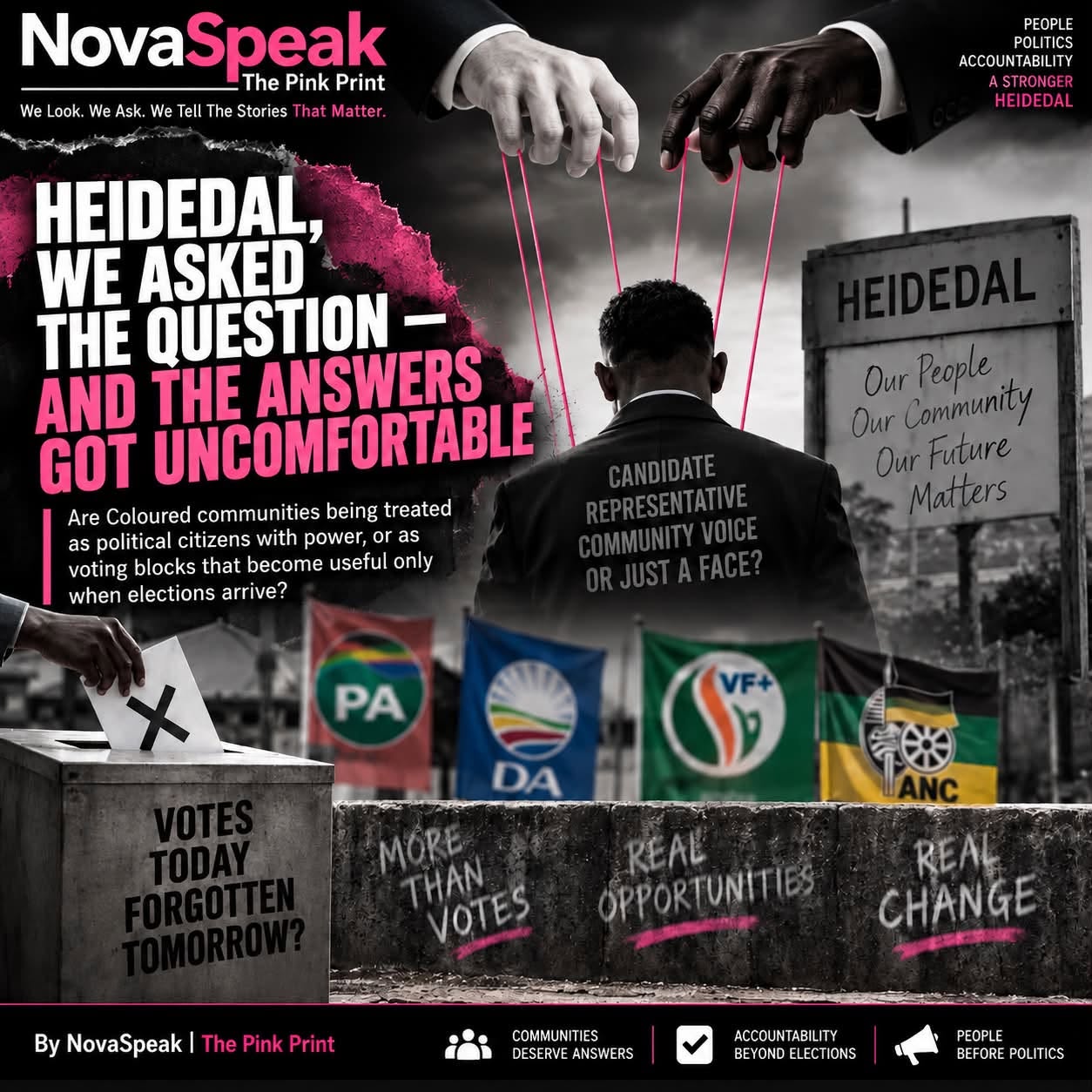
Are Coloured communities being treated as political citizens with power, or as voting blocks that become useful only when elections arrive?
NovaSpeak put a simple but uncomfortable question directly to political parties and Ward 16 candidates: Are Coloured communities being treated as political citizens with power, or as voting blocks that become useful only when elections arrive? The answers did not produce political agreement. Instead, they exposed something more revealing — a deep divide over who really holds power inside political parties, who gets to make decisions, and whether the people sent into communities to win votes have enough influence to fight for those communities once the election is over.
For Patriotic Alliance representative Gregory Werner, the answer was an emphatic yes. Werner argued that Coloured communities across South Africa have for decades been treated as reliable voting blocs — courted during elections, promised economic upliftment and praised when their votes are needed, only to be forgotten once the ballots have been counted. But Werner did not stop there. He turned the question back towards the political parties themselves and issued a challenge: show us who really holds the power.
He called on the Freedom Front Plus to reveal its management and senior leadership structures, its candidates and the people working to mobilise votes on its behalf. He challenged the DA to do the same in Mangaung — to show its top leadership structure and its candidate list. His argument was that voters should look beyond the faces presented to them during election campaigns and examine the structures behind those faces. Who makes the decisions? Who controls the political machinery? Who gets the positions? Who gets the opportunities? And where, exactly, does the ordinary community member fit once the votes have been delivered?
Werner's challenge was blunt: if the accusation is wrong, prove it wrong. And that is where the debate becomes bigger than one party, one candidate or one election, because a political candidate can be the face of a campaign without necessarily being the person who controls the political decisions behind it. A candidate can knock on doors in Heidedal, speak to residents, understand their frustrations and ask them for their votes — but once elected, how much freedom does that representative actually have to challenge the party they serve?
Is the councillor answerable first to the community, or to the political structure that put them on the ballot? And what happens when those two interests collide? That is the uncomfortable question sitting underneath the entire Ward 16 debate, because political representation means little if the person residents elect cannot meaningfully influence the decisions affecting those residents.
That tension became even more visible when Werner's comments were challenged by DA representative Attie Terblanche. Terblanche repeatedly pointed to party rules, arguing that political representatives cannot simply say whatever they want because they operate within the structures and rules of their respective organisations. Werner's response was equally direct: if public representatives are going to debate politics, municipalities and the problems facing their constituents, then they cannot avoid talking about the parties they represent.
The exchange may have sounded like another political argument, but beneath the disagreement was an issue voters should pay close attention to: party discipline is one thing; community accountability is another. Political parties have rules, and representatives are expected to operate within those rules. But councillors also represent residents who expect them to fight for their interests. So what happens when party loyalty and community demands pull in opposite directions?
That is the question voters should be asking before they put an X next to any candidate's name. Not simply what the candidate promises, but what authority they will actually have once they are elected. Not simply who appears on the poster, but who stands behind the candidate. Not simply who speaks for the party during an election campaign, but who has the power to make decisions when the campaign is over.
And perhaps that is where the so-called “puppet” question comes in. Not whether candidates are literally puppets — that would require evidence. The real question is whether political representatives have sufficient independence, authority and influence to genuinely represent the people they are asking to vote for them. Because if the candidate is merely the face while the real decisions are made somewhere else, then voters deserve to know.
Who is pulling the strings?
And more importantly:
Who benefits when the strings are pulled?