Politics
DOES GREGORY WERNER HAVE A POINT?
VF+ AND THE HEIDEDAL QUESTION: ARE COLOURED VOTERS BEING HEARD — OR SIMPLY COUNTED?
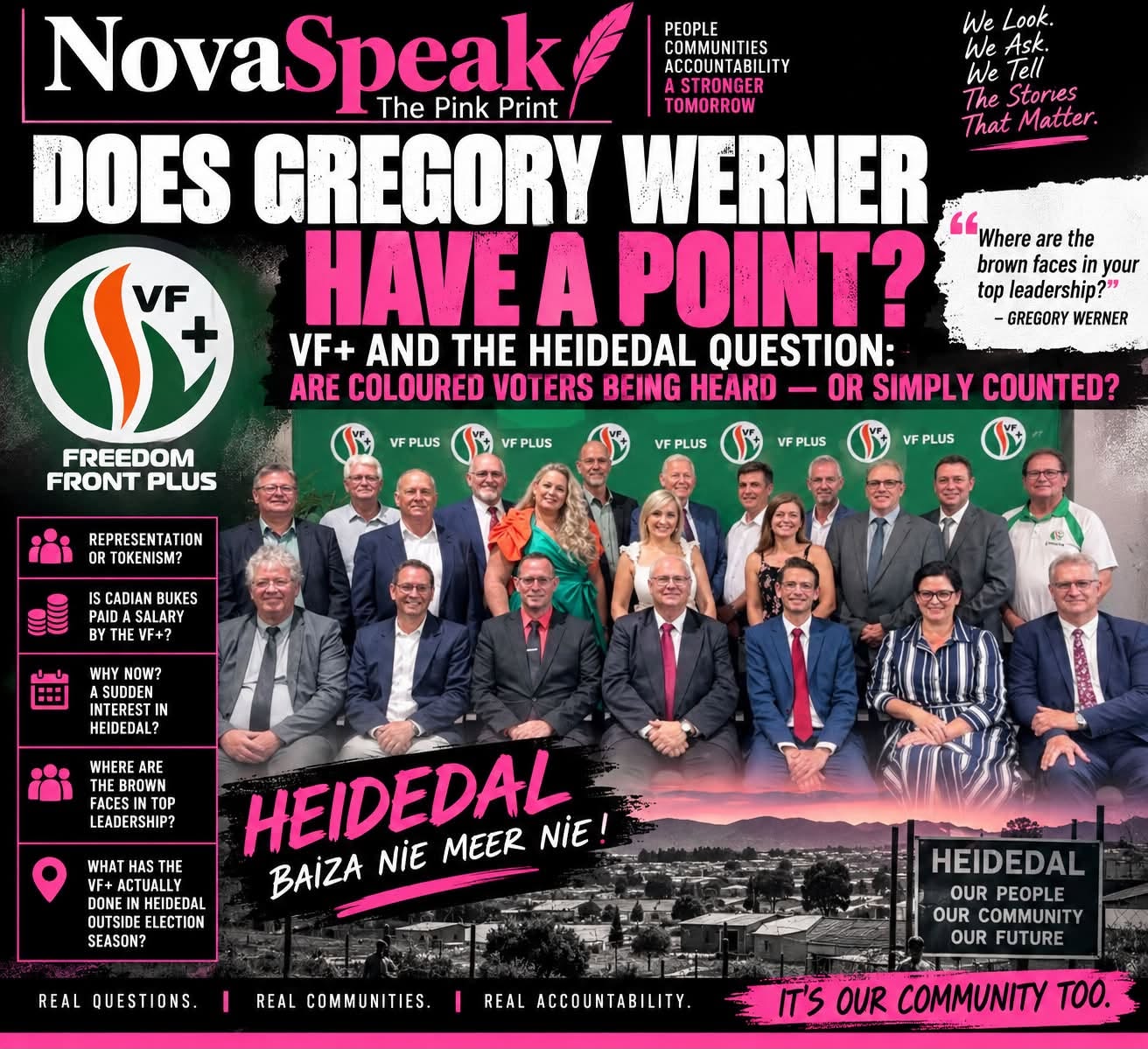
There are political questions that disappear once an election is over, and then there are questions that remain long after the posters have come down and the ballot boxes have been packed away. In Heidedal, one such question is now being placed directly on the table by community activist Gregory Werner: What does the Freedom Front Plus really see when it looks at Heidedal — a community, or a voting constituency?
Werner has issued a pointed challenge to the VF+, questioning the party’s growing presence in Heidedal and asking why, in his view, coloured South Africans appear to be welcomed when votes are being sought but remain less visible when it comes to the party’s upper leadership structures. It is a serious question, particularly at a time when the VF+ says it is expanding its support among communities beyond its traditional voter base. In January 2026, VF+ leader Corné Mulder said the party had experienced an influx of new members from diverse communities, including black South Africans.
That claim of a broadening support base inevitably creates another question: if the party’s support base is changing, is that transformation also reflected in who gets to make decisions at the top?
The VF+’s publicly listed federal management includes national and provincial leadership structures, with positions ranging from federal chairperson and provincial leaders to chief whip, finance, legal, administration, marketing, strategy, international relations, local government, research and policy. It is against that broader leadership picture that Werner’s criticism becomes uncomfortable, because his argument is ultimately not only about one political party, one candidate or one election campaign. It is about representation and whether political support translates into meaningful participation in political power.
His challenge, in essence, is straightforward: if communities such as Heidedal are important enough for a political party to campaign in, organise in and ask for votes from, are those communities also important enough to have meaningful representation when the important decisions are made?
That question deserves an answer.
Werner has also made a specific allegation regarding Cadian Bukes, claiming that the VF+ pays Bukes a salary to perform political work in Heidedal. NovaSpeak has not independently verified that allegation, and it should therefore not be presented as established fact. The VF+ should be given an opportunity to respond directly to the claim and explain the nature of Bukes’ role and relationship with the party.
But even if that particular allegation is put aside, the larger question remains: where has the VF+ been in Heidedal, and why does its renewed political interest appear to be intensifying as the 2026 local government elections approach?
The timing matters. South Africa’s local government elections are scheduled for 4 November 2026, and political parties are positioning themselves for what is expected to be a fiercely contested electoral period. The VF+ has openly indicated that it wants to play a greater role in local government following the elections. For residents watching political activity increase around them, that naturally creates an opportunity to ask what this renewed attention actually means for the community.
Where were you before the election calendar arrived?
That question should not automatically be interpreted as an accusation of bad faith. Political parties have a democratic right to organise, recruit members, campaign and seek support in communities where they believe they can make a difference. Nor does the arrival of the VF+ in Heidedal mean that its intentions are necessarily insincere. But democracy must also allow communities to question political parties about their motives, their record and their plans without those questions being dismissed simply because they are uncomfortable.
For Werner, the issue is tied to a much broader frustration around coloured representation and political influence. South Africa has spent more than three decades in democracy, yet questions surrounding race, representation and access to leadership remain relevant. The Commission for Employment Equity’s latest reporting continues to reflect significant racial disparities at senior and top-management levels across the broader labour market, reinforcing the wider debate about who occupies positions of influence and who remains outside the rooms where decisions are made.
Politics cannot be separated entirely from that conversation.
A community cannot simply be told that its people matter because politicians arrive during campaign season, shake hands, take photographs and ask for votes. People have every right to ask what happens after the votes are counted. Who gets the positions? Who gets the opportunities? Who gets to sit around the table? Who gets to make the decisions? And perhaps most importantly, who remains important when there is no election taking place?
Those questions become even more significant when viewed against Werner’s history of activism in Heidedal. He has previously been recognised as Heidedaller of the Year for his work highlighting challenges facing the community, including the abandoned quarry, sewage problems and poverty. That history provides context for why he is now questioning political parties seeking support in the area.
Whether residents agree with Werner or not, his criticism speaks to a frustration that exists far beyond one political organisation: the feeling among some communities that ordinary people become highly visible when their votes are required and considerably less visible once the campaign ends.
And that is where the VF+ has an opportunity to do more than simply dismiss the criticism.
It can answer it.
How many coloured South Africans occupy meaningful leadership positions within the party? What opportunities does the VF+ create for young people from communities such as Heidedal? If the party’s support is expanding among communities previously less associated with its traditional base, is that changing the composition of its leadership? What has the VF+ actually done in Heidedal outside the election cycle? And what is its long-term plan for the community after 4 November 2026?
Those are not unreasonable questions. They are democratic questions.
They also cannot be answered simply by pointing to campaign activity.
Because Heidedal is not merely a voting district. It is a community made up of families, workers, pensioners, young people, entrepreneurs, students and residents who have been living with their challenges long before political campaign posters began appearing. The issues facing the community do not disappear when an election ends, and neither should the politicians who ask residents to trust them with their votes.
That is where the meaning of representation becomes important.
A vote is not a blank cheque.
Political support does not automatically give a party ownership of a community.
And a political party does not earn the long-term trust of residents simply because it has managed to secure votes in one election.
It earns that trust by showing up — before the election, during the election and, most importantly, after the election.
Perhaps, then, the question raised by Gregory Werner is bigger than whether he is right about the VF+. It is whether political parties are prepared to be judged by the same communities they ask to support them.
If the VF+ believes Werner’s criticism is misplaced, it has an opportunity to explain why.
If the party believes its record in Heidedal demonstrates genuine community involvement, it can show residents what that record looks like.
If its leadership already reflects the diversity of the communities it seeks to represent, it can demonstrate that representation.
And if there are gaps, perhaps the questions being raised provide an opportunity to address them.
So, does Gregory Werner have a point?
That is ultimately for the people of Heidedal to decide.
But he has certainly asked a question that the VF+ should be prepared to answer publicly, because when the campaign posters come down, when the political speeches stop and when the ballot boxes leave Heidedal, the community will still be here.
The unemployment will still be here.
The poverty will still be here.
The social challenges will still be here.
And the people will still be watching.
NovaSpeak | The Pink Print
We Look. We Ask. We Tell The Stories That Matter.
Editorial note: NovaSpeak has treated the allegation concerning Cadian Bukes as an allegation and has not presented it as established fact. The question of racial representation within the VF+ is likewise framed as a matter requiring the party’s response rather than as a finding that the party excludes coloured South Africans from leadership.