Investigations
MANGAUNG HAS THE HISTORY — SO WHERE IS THE TOURISM STRATEGY?
WHAT DOES THE CHOICE OF VENUE SAY ABOUT HOW MANGAUNG UNDERSTANDS TOURISM?
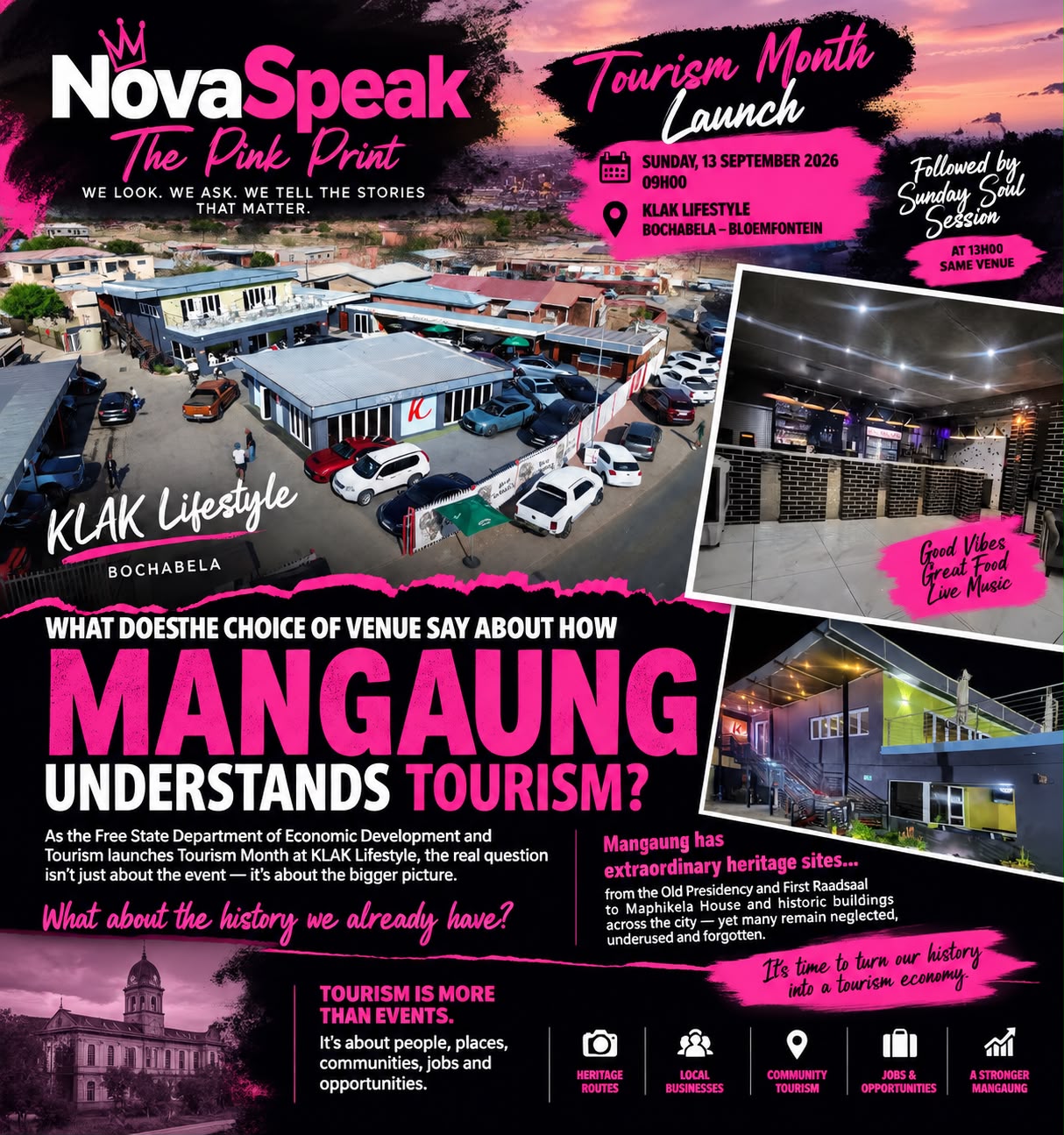
The Free State Department of Economic Development and Tourism is taking its 2026 Tourism Month launch back to KLAK Lifestyle in Bochabela on Sunday, 13 September — a choice that raises a bigger question about what Mangaung believes tourism should look like, and whether the city is making enough use of the extraordinary history, heritage and communities already on its doorstep.
The official programme is scheduled to begin at 09h00, before a Sunday Soul Session takes over the same venue from 13h00. There is nothing inherently wrong with launching tourism at a lifestyle venue: music, entertainment, food and culture are all part of modern tourism, and bringing people into spaces they already understand can make tourism feel less like a government programme and more like a living experience.
But the choice of venue becomes more significant when placed against what exists beyond its walls.
Mangaung does not lack tourism attractions. It may lack the strategy and political urgency to turn those attractions into a sustainable tourism economy.
That is the uncomfortable question hanging over this year’s launch: if Mangaung already has heritage buildings, historic sites, cultural communities and established tourism attractions, why are so many of those assets still struggling to become functioning tourism products that bring visitors, create jobs and generate opportunities for local businesses?
The Free State’s own tourism information lists a remarkable collection of Bloemfontein heritage attractions, including Maphikela House, Dikgareteneng Houses, the Old Presidency, Bram Fischer House, City Hall, the Appeal Court, First Raadsaal, Fourth Raadsaal, Jubileum Building, Klein Magasa Hall, Lebohang Building, the Freshford House Museum and others.
The province’s tourism strategy goes further, identifying attractions across the Mangaung area as part of the Cheetah Route, including Naval Hill, Franklin Game Reserve, Maphikela House, the Old Presidency, the Appeal Court, First and Fourth Raadsaal, Oliewenhuis Art Museum, the National Women’s Memorial, the National Museum and the National Afrikaans and Sotho Literature Museum.
So the question is not whether Mangaung has something to sell.
It is whether Mangaung is selling what it already has.
Take the First Raadsaal. It is not simply an old building. Dating to 1849, it is recognised as the oldest surviving building in Bloemfontein, and its walls have witnessed the city’s early political, religious and educational development. It served as a school, church, legislative chamber and government offices before becoming part of the city’s museum heritage.
Then there is the Old Presidency, once the official residence of three presidents of the former Orange Free State Republic and today a museum and cultural space. There is also Maphikela House in Mangaung Township, a site directly connected to the political history of South Africa. Historical records document gatherings there involving prominent black leaders and identify Thomas Mtobi Maphikela as a founder member of the ANC’s Executive Committee in Bloemfontein. The house itself is a national monument.
These are not simply old buildings sitting on a tourism register.
They are stories, classrooms, potential tourism routes, potential jobs and potential businesses.
They could give visitors reasons to stay in Mangaung rather than simply pass through it. They could create opportunities for local guides, transport operators, restaurants, guesthouses, artists, photographers, performers and small businesses. They could also allow residents themselves to become part of the tourism economy by telling the stories of the communities in which they live.
Yet somewhere between possessing this extraordinary heritage and actually building a thriving heritage-tourism economy around it, something appears to have been lost.
The city can announce Tourism Month. It can bring the media together. It can create a lifestyle event. It can put music and entertainment on a programme. But the more difficult question is what happens when the event ends.
Where is the tourist taken next?
Where are the heritage walking routes connecting the old city to the communities that shaped it? Where are the properly packaged township tourism experiences? Where are the young people being trained to become local heritage guides and storytellers? Where are the tourism products connecting Batho, Bochabela, Heidedal, Thaba Nchu and Botshabelo to the broader Mangaung tourism economy?
And what happens to the heritage buildings that are not receiving the same attention as the city’s better-known attractions?
The National Museum itself acknowledges that Bloemfontein’s historical landscape has already lost buildings over the years. Its Mangaung history exhibition records historic architecture, including buildings that have since been demolished, alongside surviving heritage structures.
That should make every Tourism Month celebration pause for a moment.
Because once a historic building disappears, no new tourism campaign can simply recreate the history that has been lost.
It is gone.
That is why the KLAK question is ultimately not really about KLAK.
It is about priorities.
If government wants contemporary tourism and lifestyle to form part of Mangaung’s tourism identity, then that can be embraced. But entertainment should become a gateway into the history, culture and communities that make Mangaung distinctive, rather than becoming the destination itself.
Imagine visitors starting with music and food in Bochabela before moving into a carefully designed heritage route through Mangaung. Imagine walking through Batho with a local storyteller, visiting Maphikela House and hearing its political history from someone who understands the community, travelling through Heidedal to experience its cultural history, food, music and people, and visiting the First Raadsaal, the Old Presidency and President Brand Street not as isolated attractions but as chapters in one living story.
Imagine young people being trained to guide those visitors, while local photographers, shuttle operators, restaurants, guesthouses, artists and performers benefit from every tourist who arrives.
That is what tourism can become when heritage is treated as an economic asset rather than something government remembers during Heritage Month.
The irony is that Mangaung does not need to invent an attraction.
The attraction is already here.
The stories are already here. The buildings are already here. The communities are already here. What is missing is the stronger connection between those assets and a tourism economy that operates throughout the year rather than simply during an official launch.
Because a tourism launch should ultimately launch something.
Not just an event.
Not just a programme.
Not just a Sunday afternoon.
It should launch a vision.
A vision where Mangaung’s history is protected instead of allowed to disappear. A vision where neglected heritage becomes restored heritage. A vision where heritage becomes employment. A vision where tourism money reaches communities. A vision where young people can look at an old building and see an opportunity rather than a forgotten structure.
So as officials gather at KLAK Lifestyle on Sunday to officially launch Free State Tourism Month, perhaps the most important question is not what entertainment is on the programme.
It is what comes next.
What does the choice of venue say about how Mangaung understands tourism — and what does Mangaung intend to do with the extraordinary tourism story already standing outside its doors?
Because Mangaung has the history.
It has the culture.
It has the people.
It has the stories.
Now it needs the strategy, investment and political will to make those stories worth travelling for.
NovaSpeak | The Pink Print
We Look. We Ask. We Tell The Stories That Matter.