Politics
THE INVESTIGATION MAY BE OVER, BUT THE ACCOUNTABILITY FIGHT IS NOT
SELLO MORE PROBE
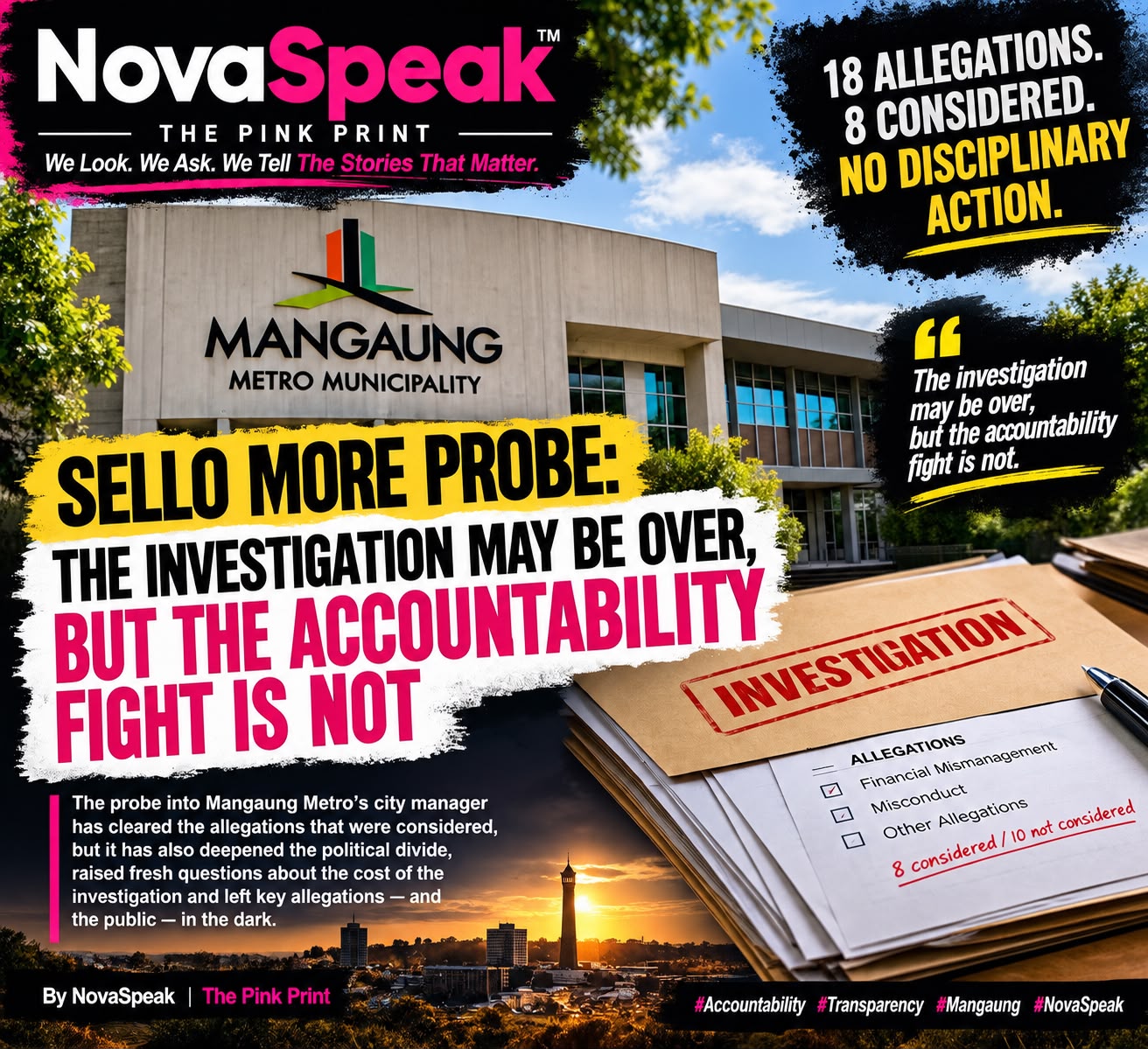
The investigation into Mangaung Metro City Manager Sello More has cleared the allegations that fell within its scope, but it has also left behind a far more uncomfortable question: what exactly has been put to rest and what remains unanswered?
The independent investigation, commissioned in late July after 18 allegations were raised against More, concluded without recommending disciplinary action. But according to the Mangaung Metro, the investigator considered only eight of the 18 allegations.
That distinction has become the fault line in an increasingly bitter political battle over More, the cost of the investigation and the standards being applied to accountability inside one of the Free State’s most troubled municipalities.
Acting General Manager for Communications Nicolette Maysiels confirmed that none of the allegations that fell within the investigator’s scope were substantiated.
“The allegations could not be sustained and disciplinary action in terms of the Local Government: Disciplinary Regulations for Senior Managers, 2010, was not recommended,” Maysiels said.
On paper, that should have brought the matter closer to an end.
Instead, it has triggered competing versions of what the outcome means.
PA ward 16 councillor Gregory Werner has seized on the findings as vindication for More and an indictment of the Democratic Alliance, accusing the party of turning the investigation into an expensive political campaign.
“The clear outcome has officially exposed the DA’s relentless campaign for what it truly was: a costly, politically motivated witch hunt,” Werner said.
His criticism goes beyond the allegations themselves. Werner alleges that millions of rand in municipal funds were consumed by legal and investigative costs, money he argues could have been spent on the basic failures residents continue to confront — potholes, sewage leaks, water infrastructure and broken streetlights.
If that expenditure is confirmed, it raises a question that extends beyond the More investigation: how much does political and administrative conflict ultimately cost the residents of Mangaung?
But the DA is refusing to accept the investigation’s conclusion as the end of the story.
DA ward councillor Tjaart van der Walt said the party had noted council’s decision not to institute disciplinary proceedings, but maintained that it needed to see the full investigation report and supporting documentation before deciding what action to take.
“The DA will now demand the full investigation report, request the municipal manager’s representations and evidence, study the report and any further documentation we request, and determine a way forward,” Van der Walt said.
That demand places the spotlight directly on the report itself.
Because while the Metro says the allegations considered by the investigator could not be substantiated, the fact remains that eight allegations were considered out of an original 18. That does not, by itself, mean the remaining allegations are valid. Nor does it mean they were disproved. It means the public debate cannot honestly treat the investigation’s findings as though all 18 allegations were tested and dismissed.
And that is precisely where the political rhetoric risks getting ahead of the evidence.
For Werner, the outcome demonstrates that the DA’s campaign against More was politically motivated. For the DA, the outcome cannot be properly assessed until the underlying evidence and full report have been examined.
The residents of Mangaung are therefore left with an uncomfortable middle ground: a city manager who will not face disciplinary action on the allegations investigated, opposition councillors demanding access to the evidence, and competing political parties already attaching radically different meanings to the same outcome.
The real test now is transparency.
If public money was spent investigating allegations involving a senior municipal official, residents have a legitimate interest in understanding what was investigated, what evidence was considered, why only eight allegations fell within the scope, what the investigation cost and what ultimately informed council’s decision.
The question is not whether More has been found guilty.
He has not.
The question is whether Mangaung is prepared to place enough of the process in the public domain for residents to judge the outcome for themselves.
Because accountability cannot simply mean commissioning an investigation when political pressure becomes too loud. It must also mean being able to explain, transparently and convincingly, what was investigated, what was not, what it cost — and why the final conclusion should be trusted.
For now, the More investigation has produced one clear result: no disciplinary action was recommended on the eight allegations considered.
Everything beyond that remains contested.
And in Mangaung, where public trust is already under pressure, an investigation ending is not necessarily the same thing as accountability being achieved.