Community
“People died for us to have this right to vote today”
On Wednesday, 19 August 2026, where Mangaung Metropolitan Municipality, in partnership with the Independent Electoral Commission (IEC), brought voter education directly into a community preparing for the 2026 Local Government Elections. The message was bigger than ballot papers, voting stations and political parties: it was a reminder that South Africa’s democracy was built on sacrifice, and that the right to decide who governs communities is not something citizens should ever take for granted.
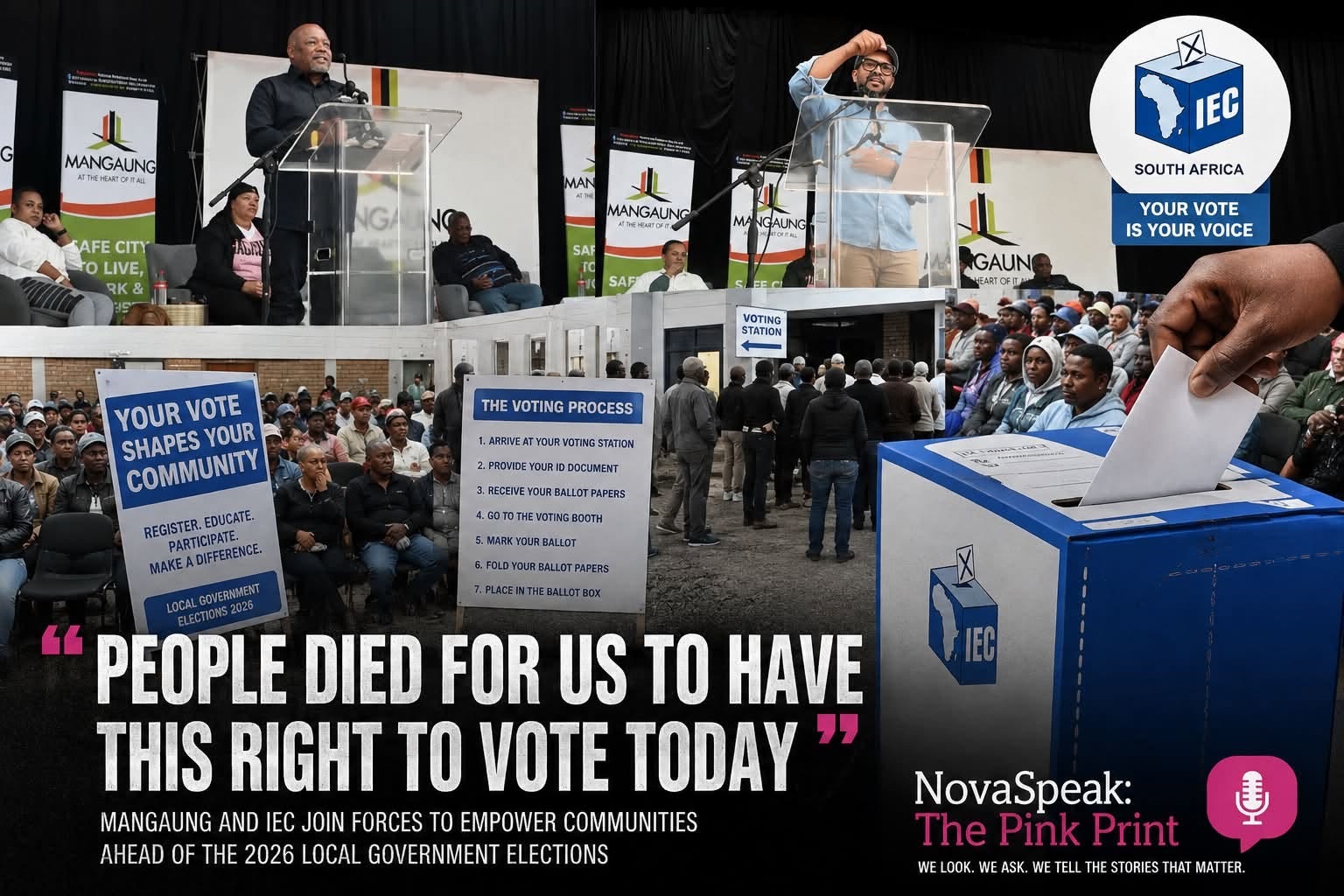
“People died for us to have this right to vote today.” Those words from Gregory Werner cut through a packed Norman Doubell Hall in Heidedal on Wednesday, 19 August 2026, where Mangaung Metropolitan Municipality, in partnership with the Independent Electoral Commission (IEC), brought voter education directly into a community preparing for the 2026 Local Government Elections. The message was bigger than ballot papers, voting stations and political parties: it was a reminder that South Africa’s democracy was built on sacrifice, and that the right to decide who governs communities is not something citizens should ever take for granted.
The voter education campaign brought together residents, municipal representatives and the IEC to explain how the voting process works, what happens inside a voting station, why registration and correct voter details matter, and why participation in local government elections is so important. Mangaung’s August 2026 News Update identifies Cllr Logan Kruger and Cllr Bongani Lawrence Mathae among those participating in the campaign, while Mathae is correctly identified as the Speaker of Mangaung Metropolitan Municipality. His position as Speaker is also confirmed by the University of the Free State, which records his career progression to the position he has held in Mangaung. (University of the Free State)
The campaign comes as the IEC intensifies preparations for the 2026 Local Government Elections, with voter registration, address verification, civic education and understanding the voting process forming part of the Commission’s preparations. The IEC’s strategic planning documents confirm that preparations for the 2026 local elections are already under way, including voter registration and civic education initiatives. (Elections South Africa)
For Werner, however, voter education is not simply about teaching people how to mark a ballot correctly. It is about reminding citizens that the vote gives them a voice over the people who will make decisions affecting their daily lives and that is particularly important at local government level.
“Local government is democracy at its most personal. Through LGE 2026, the IEC does not merely host an election, it protects the fundamental promise that our citizens have the right to shape the streets, services, and leadership of their daily lives. This is where policy meets the pavement,” Werner said.
The statement carries weight because local government is where politics stops being an abstract conversation and becomes part of everyday life. It is where residents encounter the consequences of decisions about roads, water, sanitation, electricity, waste removal, housing, public facilities and the development of their neighbourhoods. It is where a policy document eventually becomes either a functioning service or another promise waiting to be fulfilled. That is why local government elections arguably demand far more attention than they often receive.
A voter may not always know the name of the national minister responsible for a particular policy, but they know when the road outside their house is full of potholes. They know when their rubbish has not been collected. They know when a tap is dry, when sewage is overflowing or when a streetlight has remained broken for months. They know when a housing project has stalled and when a municipal service is simply not reaching their community. Those experiences are directly connected to local government.
The IEC’s voter-education drive is therefore attempting to close the gap between having the right to vote and understanding the power of that right. The Commission has reported extensive civic and democracy education work nationally, with more than 34,000 civic and democracy education events reaching more than 6.6 million people, demonstrating the scale of the effort to prepare communities for the upcoming elections. The importance of that work becomes even clearer when voter participation is considered. South Africans have historically participated more strongly in national elections than local government elections, despite the fact that municipalities make decisions that directly affect the communities in which people live, a local election can therefore be seen as democracy at its closest point to the citizen.
It is not simply about choosing a political party.
It is about choosing the people who will sit in council chambers and make decisions about the places people call home.
It is about deciding who deserves another term.
It is about asking whether previous promises became reality.
It is about examining municipal performance rather than simply voting along traditional political lines.
And it is about recognising that a ballot paper can become one of the most powerful accountability tools available to an ordinary citizen.
That is why voter education has to go beyond election day, it must reach the first-time voter who has never entered a voting station, it must reach the young person who believes politics has nothing to do with them, it must reach the resident who has become so frustrated with poor service delivery that they believe staying at home is the only way to express their anger, and it must reach the voter who has forgotten that democracy only works when citizens participate in it.
The IEC’s work also includes helping voters understand the practical mechanics of elections. The Commission has highlighted the importance of voters having their registration details and addresses correctly recorded because these details determine where voters belong within the electoral system and their ward. Its preparations for LGE 2026 include voter registration and address verification as important components of the process. (Elections South Africa)
That information becomes particularly important in communities where people move because of employment, housing or family circumstances.
Your address determines your ward.
Your ward determines who represents you locally.
And the people you elect locally have a direct influence on the services and decisions affecting your community.
The Heidedal campaign therefore comes at an important time for Mangaung itself. The metro is preparing for a fiercely contested local government election, with political parties expected to place their records, promises and plans before voters in the months ahead, for voters, this should create an opportunity to ask difficult questions.
Has my ward improved?
Have municipal services improved?
Has my councillor listened?
Were promises made at the previous election fulfilled?
Has the municipality spent public money responsibly?
Are residents being treated with dignity?
Are young people being given meaningful opportunities?
Are housing developments progressing?
Are water, sanitation, electricity and roads being properly maintained?
And perhaps the most important question of all:
Do I believe the people asking for my vote have earned it?
Those questions are the practical meaning of Werner’s argument that local government is “democracy at its most personal.” Because this is where policy meets the pavement. A national policy might promise improved infrastructure, but local government is where residents discover whether the road was actually repaired, housing policy might promise dignity, but the municipality is where residents discover whether a house was actually built, a water policy might promise access, but communities discover its success when they turn on the tap.
That is the difference between democracy as an idea and democracy as lived experience. The IEC is not merely preparing voters to enter a voting station. It is preparing citizens to participate in one of the most important mechanisms through which they can shape the future of their communities and that brings the conversation back to Werner’s warning:
“People died for us to have this right to vote today.”
Those words should not be treated as a campaign slogan, they should be understood as a responsibility, the right to vote was not always available to every South African. Generations fought, suffered, were imprisoned and died for a democratic system in which citizens could determine who governs them.
Today, the ballot is available.
The question is whether citizens will use it, because democracy does not become stronger simply because an election is held. It becomes stronger when citizens understand their rights, participate meaningfully, scrutinise those seeking power and hold elected representatives accountable after the votes have been counted and that accountability does not begin and end with national politics.
It begins at home.
It begins in the ward.
It begins on the street.
It begins with the services people receive or do not receive — every day.
That is why the 2026 Local Government Elections should not be viewed as merely another date on the political calendar. They are an opportunity for communities to decide what kind of local government they want, who they trust to lead it and whether the promises made before the election will finally become measurable improvements after it. The ballot paper may only take seconds to complete, but the decision behind that mark can shape an entire community for the next five years.
So when the doors of the voting station open, the question should not simply be who are you voting for?
It should be:
Who has earned your vote?
Who will protect your community?
Who will listen when the tap runs dry?
Who will answer when the sewage spills?
Who will account for the money?
Who will fight for the roads, schools, housing and services your community deserves?
And who will remember that political power does not belong permanently to a party, it belongs to the people who lend that power to their elected representatives through the ballot box?
Because, as Werner reminded the people of Heidedal, people died for us to have this right to vote today, the greatest way to honour that sacrifice is not merely to remember it.
It is to use the right they fought for and when the votes are finally counted, democracy will once again have spoken, not from a podium, not from a political manifesto, but from the hands of ordinary South Africans who decided to make their mark.
NovaSpeak: The Pink Print
We Look. We Ask. We Tell The Stories That Matter.