Opinion
MANGAUNG MAYORAL DEBATE:
THE QUESTIONS THAT WERE LEFT ON THE TABLE
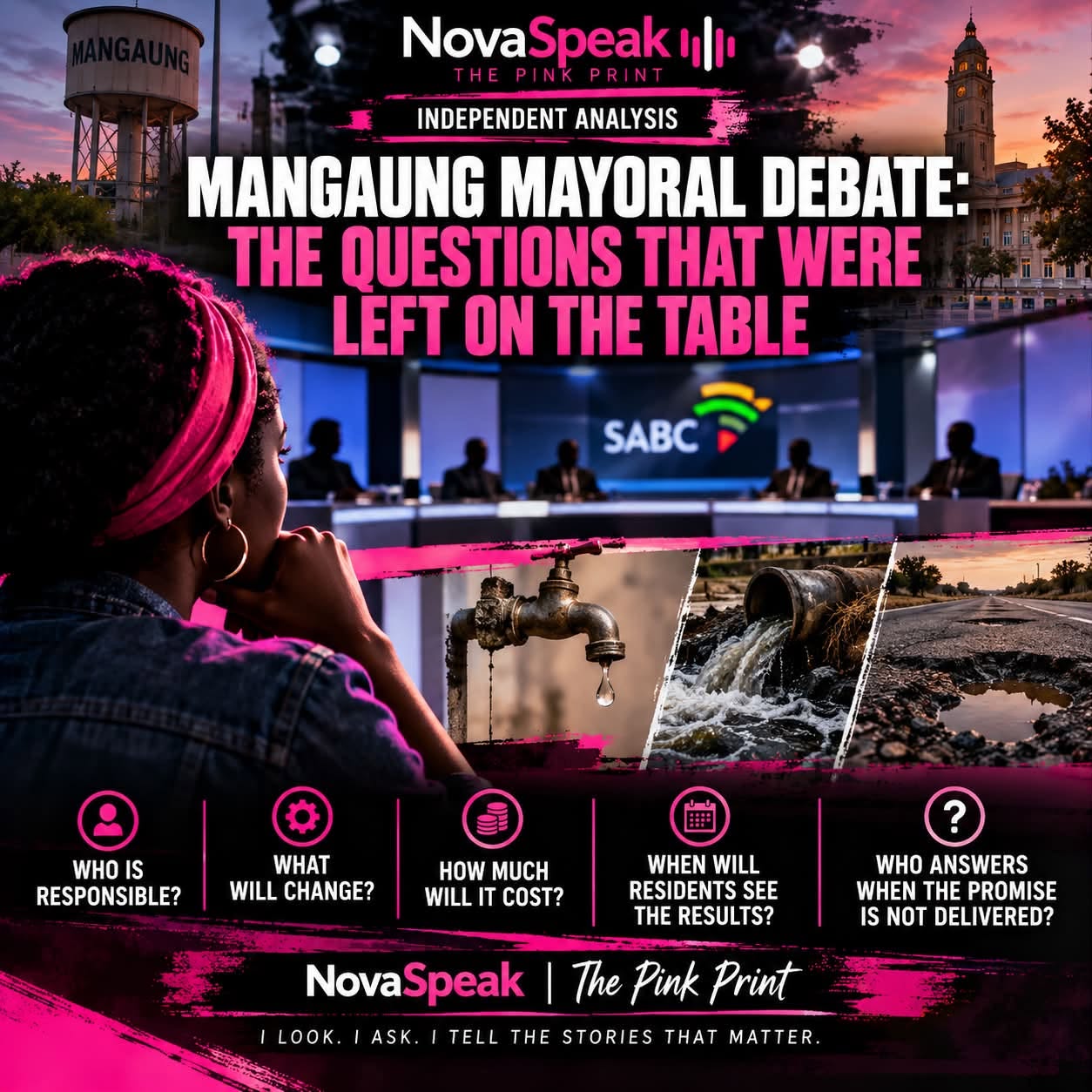
The SABC Mangaung Mayoral Debate gave candidates an opportunity to explain their visions for the metro, but it left a more important question hanging over the election: did voters hear enough about who is responsible for Mangaung’s failures, what will actually change and how anyone seeking to govern the city intends to deliver it?
The candidates spoke about service delivery, municipal finances, development and the future of Mangaung. Those issues matter. But a mayoral debate should do more than provide candidates with an hour to outline what they believe they can do. It should force those seeking political power to confront the municipality’s record — and give residents enough information to judge whether the people asking for their votes have credible answers.
Because Mangaung is not experienced through political speeches.
It is experienced through the tap that runs dry, the sewer that overflows, the pothole that remains unrepaired, the public facility that deteriorates and the municipal account that continues arriving regardless of whether the service attached to it is working.
For residents living with those realities, saying that Mangaung needs change is not enough.
The harder question is how that change will happen, who will be responsible for delivering it and what happens when it does not.
One of the debate’s most revealing moments came during the confrontation over Mangaung’s political history and who should carry responsibility for the metro’s current condition. EFF mayoral candidate Sam Matiase accused former ANC councillors who are now contesting under other political banners of bearing responsibility for the deterioration of the municipality.
That accusation deserves more than a political exchange.
It raises a fundamental question for voters: when politicians change parties, does their record change with them?
If a candidate previously occupied a position of authority, residents should be able to ask what decisions that person supported, what they opposed, what they knew, what they challenged and what they failed to prevent.
And if that candidate is now presenting themselves as part of the solution, the obvious follow-up is simple: what would they do differently this time?
That standard cannot apply only to former ANC councillors.
It should apply to every candidate who has previously held political or administrative influence in Mangaung.
Past performance matters because elections are not only about future promises. They are also about deciding whether voters trust a person or political organisation with another opportunity to exercise power.
The debate also raised familiar promises around municipal competence and financial management. The FF Plus, for example, argued that residents should see a return on the money they pay in rates and taxes, while its mayoral candidate Armand Cloete spoke about placing competent people in critical municipal positions and improving maintenance.
Those are positions voters can assess.
But the next question should always be the uncomfortable one:
How?
How much would the proposed changes cost? Where would the money come from? Which municipal departments would be affected? What would happen to officials who fail to perform? How would political office-bearers be held accountable? And when would residents actually be able to see measurable improvement?
Without those details, even a compelling political promise remains just that — a promise.
This is where political debates can become too comfortable.
Candidates can speak about transformation, development, economic growth, service delivery and accountability without being forced to attach those promises to measurable targets, deadlines or consequences.
But residents do not live inside election manifestos.
They live in the present.
A burst pipe does not wait for a five-year plan. A sewage spill does not care which party wins an election. A deteriorating road does not improve because a candidate promises better maintenance. A young person without work needs more than a statement about economic development.
The gap between political language and lived reality is therefore where the most important questions should be asked.
Mangaung already produces financial, budgetary, planning and oversight documents, including its 2026/27 budget and Service Delivery and Budget Implementation Plan.
The issue is not simply whether plans exist.
It is whether those plans translate into services residents can see.
That means the next question to a mayoral candidate should not merely be, “What is your plan for Mangaung?”
It should be:
Which existing problem will you fix first, what will it cost, where will the money come from, when should residents expect results, and who takes responsibility if you fail?
That question changes the nature of the political conversation.
It moves the candidate from aspiration to implementation.
It moves the voter from listening to measuring.
And it turns accountability from a campaign slogan into something that can actually be tested.
NovaSpeak is not suggesting that a mayor can personally solve every problem in Mangaung. Municipal government operates through systems, departments, officials, budgets and legal frameworks. Some challenges also require intervention from provincial or national government.
But that makes clarity even more important.
Candidates should tell residents what falls within the municipality’s powers, what requires cooperation from other spheres of government and what they believe can realistically be achieved with the resources available.
They should also explain what happens when those systems fail.
Because accountability is not only about claiming success.
It is about accepting responsibility when the promised outcome does not materialise.
For voters, that should be one of the central tests of this election.
Look at the record.
Listen to the promises.
Ask for the numbers.
Ask for the timelines.
Ask who is responsible.
And then ask what mechanism exists to hold that person accountable.
The SABC debate opened an important conversation, but the harder conversation belongs to Mangaung’s voters.
They do not simply need candidates who can speak convincingly about the metro.
They need candidates who are prepared to explain how they intend to govern it.
Because Mangaung does not need another political conversation in which everyone gets a turn to speak.
It needs one in which candidates are prepared to answer the questions residents have been asking for years:
Who is responsible?
What will change?
How much will it cost?
When will residents see the results?
And who answers when the promise is not delivered?
Those questions should not be considered hostile.
They are the questions democracy is supposed to make possible.
And ultimately, that is what a mayoral debate should give voters — not simply more political speeches, but enough information to distinguish between a promise, a plan and a commitment that can actually be measured.
NovaSpeak | The Pink Print
We Look. We Ask. We Tell The Stories That Matter.